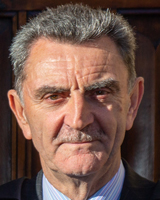
A journalist, who played a key role in charting the major resurgence and impact of the city’s Freemen across the last 15 years, has stepped down as press officer. George Oliver first retired in 2009 after 17 years as Durham Constabulary’s press and public relations manager after a career which started in the autumn of 1963.
A year later he joined the Freemen’s trustees and witnessed the start of a roller-coaster which saw membership treble and many tens of thousands of pounds donated to worthy causes across the city and surrounding area.
His professional life started in the city’s Saddler Street as a trainee journalist, indentured for three years to Bert Wilson, an army major who served in the Far East during the Second World War.
Bert returned to his former profession in regional newspapers before launching a freelance news agency in the 1950s, serving regional and national newspapers, and the region’s radio and television stations.
George, his third trainee, stayed for seven years before joining an evening newspaper, leaving in 1992 as a chief reporter to take up his police appointment.
A career irony, unrelated to his first boss, came in 1984 with an invitation to join a new specialist British Army unit – set up following a Parliamentary review of the Falklands War.
He underwent basic infantry training – at the same time becoming one of the first new recruits inducted into a 50-strong part-time team of TV, radio, and print journalists. His first commanding officer was an assistant director general of the BBC of the team based in Army HQ in Salisbury.
Travel was the unit’s bi-word and over more than a decade took George across the UK and Europe many times. He was put on “notice to move” at the start of the first Gulf War in 1991– the alert subsequently shelved because of the short duration of the conflict. He did, however, briefly spend time with British troops in the Kuwaiti desert immediately afterwards.
Subsequent assignments he was unable to take up during eleven years with the unit, a result of commitments of his police headquarters “day job,” included exercises and operations inside the Arctic Circle, South America, the Far East and South Pacific islands.
On one occasion he was available to join the British Army Training Team in South Africa. Their task – to instill in seasoned ANC guerrilla fighters the discipline and habits of regular troops. George’s task – to identify and exploit all media opportunities. Sadly, the guerrillas all walked out of their up-country barracks without notice – two days before he and the team were due to fly out.
In 2010, a year into his first retirement, his pal John Heslop, a retired head and Chairman of the Wardens, suggested he become one of the Freemen’s nine trustees, the timing coinciding with the start of a “golden age” of giving in the Freemen’s history.
It was also, by another happy coincidence, linked to the Freemen’s unanimous agreement – in the wake of the 2010 Equality Act – to admit women to what had been since the Middle Ages, an all-male preserve. The result was a steady growth in membership, from 90 to the present-day total of 270 – and rising.
“Charitable giving to scores of good causes in the city since 2010 has totaled well in excess of £400,000 – something every member of the Freemen has the right to feel enormously proud of,” said George.
George, a member of the Butchers’ Company, insists he has been lucky to have met and worked with some gifted people from the professions, businesses and craft trades from within and around Durham and beyond. Not least among them is the Freemen’s former official photographer Geoff Kitson, a gifted plumber who has been taking snaps since his dad gave him a camera when he was nine.
“Geoff and I have had some real fun working together over many years and I’ve also had been privileged to see some of his bespoke plumbing creations in lead in both the cathedral and the roof of Durham Castle. But these are not the only legacy of his craftsmanship which are still in evidence across the city and beyond.
Bryan Proud, secretary to the Freemen said: “We thank George for all the good work he has done for the Freemen.”